
 Browse 28 Products
Manufacturing and distribution facilities play a critical role in the global supply chain, with loading docks serving as one of the most active and high risk areas of operation. Whether a facility operates dozens of dock doors or just one, the safety challenges at the loading dock remain largely the same. Understanding these risks and how to mitigate them is essential to protecting workers, equipment, and cargo.
According to Material Handling & Logistics magazine, fatalities and serious injuries at loading docks occur more frequently when there is “unwanted separation between the trailer or truck being loaded and the loading dock.
Why Trailer Separation Is a Serious Loading Dock Hazard
One of the most common and dangerous loading dock incidents occurs when there is unintended separation between a truck or trailer and the dock. This can happen due to premature pull-away, trailer creep during loading, or miscommunication between dock personnel and drivers.
Industry safety studies have shown that forklift operators are particularly vulnerable during these incidents. A forklift can drive off the edge of the dock if a trailer pulls away unexpectedly, potentially causing severe injury or fatality while also damaging valuable goods. In some cases, forklifts and operators have remained inside trailers as they depart the dock—an extremely dangerous scenario
It is not uncommon for situations to occur where the forklift and driver are still in the truck trailer when it departs from the loading dock. Of the 96 deaths that occurred at loading docks between 2002 and 2009, 11 of those were due to separation between the trailer and dock.
One of the many products that help to reduce the risk of accidents at the loading dock are vehicle restraints installed at the loading dock face to prevent unintended movement of a truck or trailer. A heavy duty steel hook mechanism connects to the ICC bar to minimize trailer creep during loading and unloading procedures, or even premature vehicle pull away. Truck restraints are often used in addition to other pieces of loading dock equipment. Using wheel chocks in conjunction with a dock restraint system further promotes the safety of loading dock workers.
Vehicle Restraints: A Primary Line of Defense
Vehicle restraints are one of the most effective tools for reducing the risk of trailer separation accidents. Installed at the dock face, these systems physically secure the truck or trailer during loading and unloading operations.
Most vehicle restraints use a heavy-duty steel hook that engages the trailer’s ICC bar, helping prevent:
Trailer creep
Unintended vehicle movement
Premature pull-away from the dock
Vehicle restraints are often used alongside other dock safety equipment to create a layered approach to risk reduction.
Enhancing Safety with Wheel Chocks and Dock Signal Lights
While vehicle restraints provide a strong mechanical connection, additional safety measures further improve dock operations:
Wheel chocks offer a secondary physical barrier against vehicle movement and are commonly used in conjunction with restraint systems.
Dock signal lights, mounted both inside and outside the dock door, provide clear visual communication between dock workers and truck drivers. Red and green light systems indicate when it is safe to enter a trailer and when a driver is cleared to depart. These lights can be manually operated or automated, depending on the restraint system in use.
Clear signage near signal lights reinforces proper procedures and helps reduce miscommunication at the dock.
Manual vs. Automatic Trailer Restraints
Facilities can choose between manual and automatic electric trailer restraint systems based on traffic volume, budget, and operational preferences.
Manual trailer restraints are often favored for their simplicity and cost effectiveness. These systems typically use a push rod mechanism that allows dock workers to engage and disengage the restraint while standing safely on the dock. Their compact design minimizes exposure to impact damage, while heavy duty steel construction ensures durability in all weather conditions.
Automatic electric trailer restraints offer push-button operation from a control panel inside the building. These systems provide consistent engagement force, integrate directly with dock signal lights, and reduce reliance on manual procedures. Many automatic restraints are surface-mounted to the dock face, eliminating the need for pits or complex concrete work during installation.
Additional Benefits of Trailer Restraint Systems
Beyond improving worker safety, installing a vehicle restraint system may offer operational and financial benefits. Some facilities find that enhanced dock safety measures can support lower insurance premiums, depending on carrier requirements and underwriting criteria. Facility managers are often encouraged to consult with their insurance provider to understand potential qualification benefits.
Guide Summary
Trailer separation is one of the leading causes of serious injuries at loading docks, but it is also one of the most preventable. By combining vehicle restraints, wheel chocks, dock signal lights, and clear operating procedures, facilities can significantly reduce risk while improving efficiency and confidence at the dock.
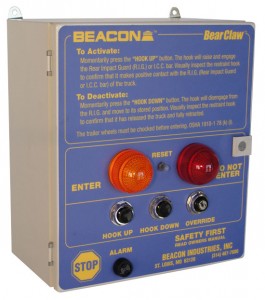
The Bear Claw BEVR650 series of automatic electric dock truck restraints feature a convenient push button control panel to engage and disengage the hook. Rated with a 50,000 pound restraining force, these units are anchored on the front dock wall face with no concrete or pit work required at installation. A 4 inch thick dock bumpers are recommended for optimum projection performance. Installing this vehicle restraint system not only enhances dock safety, but may also lead to lower insurance premiums for some customers. You may want to call your insurance sales rep that handles the insurance building policy to contact the insurance underwriter and see how you qualify.