
 Browse 28 Products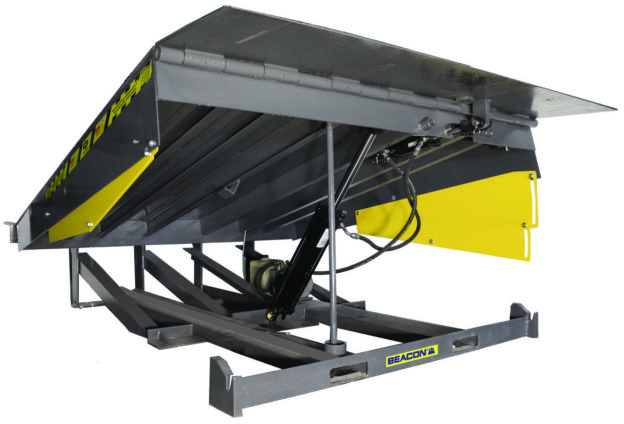
How to Choose the Right Loading Solution for Your Operation
Across the United States, businesses design their loading and unloading processes in many different ways depending on facility layout, shipping volume and operational needs. Some operations rely on large distribution centers with multiple dock doors handling high daily throughput, while others may use only a few loading docks, or no dock at all, such as manufacturing plants, construction sites, or temporary job locations.
Regardless of your application, Beacon Industries, Inc. offers proven loading solutions, including dock levelers and yard ramps, to support safe, efficient material handling across a wide range of environments.
Dock Levelers
Even when a loading dock is constructed to match standard tractor-trailer bed heights, height variations and gaps commonly occur when trucks back up to the dock face. These differences can create unsafe conditions when forklifts, pallet jacks, and personnel move materials between the dock and trailer.

Dock levelers are designed to be installed as an integral part of the building, creating a smooth transition between the dock floor and the truck bed. By bridging these gaps, dock levelers help reduce the risk of injury, minimize product damage and maintain workflow efficiency.
Beacon® Dock Levelers feature heavy duty welded structural steel construction and are engineered to provide decades of service when used according to the owner’s manual and preventative maintenance guidelines.
View Beacon’s full line of Dock Levelers:
https://www.beacontechnology.com/dock-leveler/
Key Benefits of Dock Levelers
- Permanent installation as part of the dock structure
- Designed for high cycle loading dock environments
- Available with (manual operation) or (selector switch, push-button or touch screen controls)
- Provide a stable connecting platform between dock and truck
- Allow forklifts and hand trucks to move safely and efficiently
Dock levelers are ideal for facilities with dedicated loading docks that handle consistent daily truck traffic and require fast, repeatable loading operations.
Yard Ramps
In applications where a permanent loading dock is not available, yard ramps provide a flexible and effective alternative. Yard ramps are commonly used at outdoor job sites, temporary locations, rail yards and facilities that require ground to truck access.
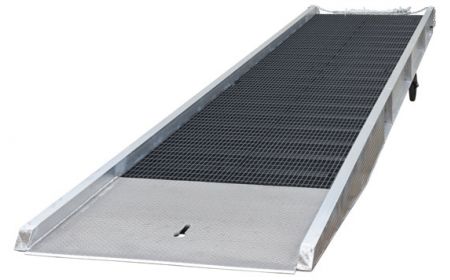
A yard ramp is typically positioned so the lip rests directly on the truck or railcar bed, transferring the load to the vehicle suspension rather than the ramp legs. This allows forklifts to drive safely from ground level into trailers without a fixed dock.
Beacon® Yard Ramps are available in both portable and stationary configurations, with options designed to match a wide range of capacities and environments.
Explore Beacon’s Yard Ramps:
https://www.beacontechnology.com/industrial-ramps/yard-ramps/
Key Benefits of Yard Ramps
- Ideal when no permanent dock is available
- Portable designs with wheels and tow bars for easy relocation
- Stationary yard ramps for dedicated ground access
- Available in steel or lightweight aluminum
- Aluminum models resist corrosion and are easier to maneuver
- Safety Curbs are standard
- Optional features include handrails and forklift pickup pockets
If a free standing yard ramp is selected it can be paired with accessories such as edge of dock levelers, depending on site requirements.
Which Loading Solution Is Right for Your Facility?
Choose a dock leveler if:
- Your facility has permanent loading docks
- You handle frequent, high-volume truck traffic
- You need fast, repeatable dock-to-truck access
- Forklift traffic is continuous throughout the day
Choose a yard ramp if:
- No loading dock is available
- You need ground-level access to trailers or railcars
- Your operation is temporary or mobile
- You require flexibility to move the ramp between locations
In some operations, a combination of dock levelers and yard ramps provides the most efficient solution, depending on traffic patterns and facility layout.
Comparison Product Table
Dock Levelers vs. Yard Ramps — Key Differences
| Feature | Dock Levelers | Yard Ramps |
|---|---|---|
| Primary Purpose | Bridge dock-to-truck height differences | Provide ground-to-truck access |
| Installation | Permanent, built into dock | Portable or stationary |
| Dock Required | Yes | No |
| Typical Environment | Warehouses, DCs, manufacturing facilities | Outdoor sites, temporary locations, rail yards |
| Forklift Traffic | High-cycle, frequent | Intermittent to moderate |
| Mobility | Fixed | Portable options available |
| Operation | Manual, Air or hydraulic | Gravity-based |
| Setup Time | Always ready | Positioned as needed |
| Best For | Dedicated dock operations | Flexible, dockless loading |
Recommended Dock Leveler Types
| Dock Leveler Type | Best Application |
|---|---|
| Hydraulic Dock Levelers | High-volume distribution centers with frequent daily cycles |
| Mechanical Dock Levelers | Facilities without electrical service at the dock |
| Air Bag Dock Levelers | Cost-effective alternative with push-button operation |
| Edge-of-Dock Levelers | Limited dock height to match trailer height |
Recommended Yard Ramp Types
| Yard Ramp Type | Best Application |
|---|---|
| Portable Steel Yard Ramps | Heavy-duty outdoor loading |
| Aluminum Yard Ramps | Corrosion resistance, easier maneuverability |
| Stationary Yard Ramps | Dedicated ground access at fixed locations |
| Rail Yard Ramps | Railcar loading and unloading |
Beacon® Loading Dock Solutions
Beacon Industries, Inc. offers a complete range of dock levelers and yard ramps engineered for safety, durability, and performance. When evaluating dock levelers vs. yard ramps, Beacon’s team can help ensure your equipment is properly rated for capacity, duty cycle and dimensional requirements.
If you need help selecting the right loading solution for your application, call Beacon Industries at 314-487-7600 and ask for assistance with product selection, layout considerations and installation guidance.